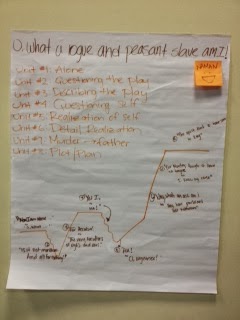
Day 1 with Mentors from Professor Werlin's class consisted of working on close reading of four soliloquys which I copy below. Students examined the context and content of the works, and plotted the rhetorical arc of the text in diagrams.
Some strategies for soliloquy study in performance:
*paraphrasing
*noting antitheses, repetitions, alliteration, assonance, operative words
*Actioning the Text (unit, objectives and actions)
*Physicalizing the soliloquy (props, staging)
*Uta Hagen's 9 questions
 Act 1: Sc.2
HAMLET:
O, that this too too sullied flesh would melt,
Thaw and resolve itself into a dew,
Or that the Everlasting had not fix'd
His
canon 'gainst self-slaughter! O God! God!(135)
How weary, stale, flat and unprofitable
Seem to me all the uses of this world!
Fie on't! ah, fie! 'tis an unweeded garden
That grows to seed; things rank and gross in nature
Possess it merely. That it should come to this!(140)
But two months dead! Nay, not so much, not two;
So excellent a king, that was, to this,
That he might not
beteem the winds of heaven
Visit her face too roughly. Heaven and earth!(145)
Must I remember? Why, she would hang on him
As if increase of appetite had grown

By what it fed on; and yet, within a month—
Let me not think on't! Frailty, thy name is woman—
A little month, or ere those shoes were old(150)
With which she follow'd my poor father's body
Like
Niobe, all tears—why she, even she—
O God! a beast that
wants discourse of reason
Would have mourn'd longer—married with my uncle,
My father's brother, but no more like my father(155)
Ere yet the salt of most unrighteous tears
Had left the flushing in her
galled eyes,
She married. O, most wicked speed, to post
With such
dexterity to incestuous sheets!(160)
It is not, nor it cannot come to, good.
But break, my heart, for I must hold my tongue!
*what are signals in the language of this soliloquy that give clues to Hamlet’s innermost thoughts? (Word choice, Construction of Phrases, Sequence of Thought) *Does he hide puns as he does with Claudius? *What does the antithesis reveal
Act 2: Sc. 2
HAMLET:
Ay, so, God be wi' ye!
Now I am alone.
O, what a rogue and peasant slave am I!
Is it not monstrous that this player here,
But in a fiction, in a dream of passion,(545)
Could force his soul so to his own conceit
That from her working all his visage wann'd,
Tears in his eyes, distraction in's aspect,
A broken voice, and his whole function suiting
With forms to his conceit? And all for nothing!(550)
For Hecuba!
What's Hecuba to him, or he to Hecuba,
 That he should weep for her? What would he do,
Had he the motive and the cue for passion
That I have? He would drown the stage with tears(555)
And cleave the general ear with horrid speech;
Make mad the guilty and appal the free,
Confound the ignorant, and amaze indeed
The very faculties of eyes and ears.
Yet I,(560)
And can say nothing! No, not for a king,
Upon whose property and most dear life
A damn'd defeat was made. Am I a coward?(565)
Who calls me villain? breaks my pate across?
Plucks off my beard and blows it in my face?
Tweaks me by the nose? gives me the lie i' the throat,
As deep as to the lungs? Who does me this? Ha!
Ha! 'Swounds, I should take it! for it cannot be(570)
But I am pigeon-liver'd and lack gall
To make oppression bitter, or ere this
With this slave's offal. Bloody, bawdy villain!
Remorseless, treacherous, lecherous, kindless villain!(575)
O, vengeance!
Why, what an ass am I! This is most brave,
That I, the son of a dear father murder'd,
 Prompted to my revenge by heaven and hell,
Must, like a whore, unpack my heart with words(580)
And fall a-cursing like a very drab,
About, my brain! Hum, I have heard
That guilty creatures, sitting at a play,
Have by the very cunning of the scene(585)
Been struck so to the soul that presently
For murder, though it have no tongue, will speak
With most miraculous organ, I'll have these players
Play something like the murder of my father(590)
Before mine uncle. I'll observe his looks;I'll tent him to the quick. If he but blench,
I know my course. The spirit that I have seen
May be a devil; and the devil hath power
T' assume a pleasing shape; yea, and perhaps(595)
Out of my weakness and my melancholy,
As he is very potent with such spirits,
Abuses me to damn me. I'll have grounds
More relative than this. The play's the thing
Wherein I'll catch the conscience of the King.(600)
*Significance of beginning phrase, now I am alone? , why does Hamlet call himself a rogue and peasant slave? *What does comparison to the player reveal about Hamlet’s self perception? *”cleave the general ear”—how does this line connect to the 27 other “ear” references in this play? *theatrical terminology *lines dealing with Hamlet’s cowardice—judge..is he a coward or not?
Act 3: Sc. 1
HAMLET:
To be, or not to be, that is the question:
Whether 'tis nobler in the mind to suffer
The slings and arrows of outrageous fortune(65)
Or to take arms against a sea of troubles,
And by opposing end them. To die, to sleep—
No more—and by a sleep to say we end
The heartache, and the thousand natural shocks
That flesh is heir to. 'tis a consummation(70)
Devoutly to be wish'd. To die, to sleep—
To sleep—perchance to dream. Ay, there's the rub!
For in that sleep of death what dreams may come,
When we have shuffled off this mortal coil,
Must give us pause—there's the respect(75)
That makes calamity of so long life.
For who would bear the whips and scorns of time,
The oppressor's wrong, the proud man's
contumely,

The pangs of disprized love, the law's delay,
The insolence of office, and the spurns(80)
That patient merit of the unworthy takes,
When he himself might his
quietus make
To grunt and sweat under a weary life,
But that the dread of something after death(85)
The undiscover'd country, from whose
bourn
No traveller returns, puzzles the will,
And makes us rather bear those ills we have
Than fly to others that we know not of?
Thus conscience does make cowards of us all,(90)
And thus the native hue of resolution
Is sicklied o'er with the pale cast of thought,
And enterprises of great
pitch and moment
With this regard their currents turn awry
And lose the name of action. Soft you now!(95)
The fair Ophelia! Nymph, in thy
orisons
Be all my sins remembered.
*Most of Hamlet’s major soliloquys are debates, arguments, discussions and/or discovereies between the self. Convert the speech into two voices. How does separating the soliloquys into a debate of two voices add to your understanding of the monologue? What are the antitheses in this monologue?
HAMLET:
I'll be with you straight. Go a little before.
How all occasions do inform against me
And spur my dull revenge! What is a man,(35)
If his chief good and market of his time
Be but to sleep and feed? A beast, no more.
Looking before and after, gave us not
That capability and godlike reason(40)
To
fust in us unused. Now, whether it be
Bestial oblivion, or some
craven scruple
Of thinking too precisely on the event—
A thought which, quarter'd, hath but one part wisdom
And ever three parts coward—I do not know(45)
Why yet I live to say 'This thing's to do,'
Sith I have cause, and will, and strength, and means
To do't. Examples gross as earth exhort me.
Witness this army, of such mass and charge,

Led by a delicate and tender prince,(50)
Whose spirit with divine ambition puff'd,
Makes mouths at the invisible event,
Exposing what is mortal and unsure
To all that fortune, death, and danger dare,
Even for an eggshell. Rightly to be great(55)
Is not to stir without great argument,
But greatly to find quarrel in a straw
When honour's at the stake. How stand I then,
That have a father kill'd, a mother stain'd,
Excitements of my reason and my blood,(60)
And let all sleep, while to my shame I see
The imminent death of twenty thousand men
That for a fantasy and trick of fame
Go to their graves like beds, fight for a
plot
To hide the slain? O, from this time forth,
My thoughts be bloody, or be nothing worth
*How does the tones of this soliloquy compare to the others? What do the arguments in previous soliloquys contribute to the argument here?


